Digging the Seam: the Miners Strike of 1984/5
25th-27th March 2010, University of Leeds.
Registration is now open for this conference, which is aimed at both HE scholars and the public, with keynote speakers representing different approaches to the ‘re-telling’ of the strike:
David Peace (author of GB84)
Julian Petley (Brunel)
Simon Popple (Leeds)
Patrick Russell and Ros Cranston (BFI)
Yvette Vanson (documentary maker) and Michael Mansfield.
Poet Ian McMillan, and the world premiere of Songs at the Year’s End with music by Hugh Nankivell.
Exhibition, performance, screenings, testimony and academic papers. With contributions from: John Hyatt (MMU, the Three Johns); Richard Crangle (Exeter), Rosemary Preece (National Coal Mining Museum for England), Sue Owen (Sheffield), Michael Bailey (Leeds Met), Patricia Holland (Bournemouth); Granville Williams; Dave Rogers (Banner Theatre); Ian Beasley (photographer) and others.
The conference looks at mainstream and alternative representations of the strike at the time, and subsequently, across the broad range of cultural expression such as the press, TV, film, performance, photography and music and song. Plus, 25 years on, how both archive study and new creative work lead us into new insights and perspectives. The conference is organised into four strands – Memory, Legacy, Media and Popular Culture, and Witness – to help compare and contrast the personal and the objective study, the artefact and the heritage industry, cultural memory and the creative.
For more information, and to register: Online registration
Or contact Dr. Eleri Pound at ics-conferences@leeds.ac.uk or on 0113 343 5805.
Organised at the University of Leeds by the Louis Le Prince Centre and the Media Industries Research Centre at the Institute of Communications Studies; with support from the School of Performance and Cultural Industries, the School of Music, Leeds International Film Festival, Opera North, and the DARE partnership.
Accommodation
We have negotiated reduced rates with Weetwood Hall hotel, quote Digging the Seam when you book for the conference rate of £70 bed & breakfast. Other hotel recommendations can be found on this page: http://www.leeds.ac.uk/visitors/where_to_stay.htm
Saturday, 6 February 2010

Thursday, 4 February 2010
CFP: Social Movements conference
SOCIAL MOVEMENTS CONFERENCE - FINAL CALL FOR PAPERS
abstracts due by Monday 22nd February 2010
From 1995 to 2009, Manchester Metropolitan University hosted a series of very successful annual international conferences on 'ALTERNATIVE FUTURES and POPULAR PROTEST'. We're very happy to announce that the Fifteenth AF&PP Conference will be held, between Monday 29th March and Wednesday 31st March 2010.
The Conference rubric remains as in previous years. The aim is to explore the dynamics of popular movements, along with the ideas which animate their activists and supporters and which contribute to shaping their fate. Reflecting the inherent cross-disciplinary nature of the issues, previous participants (from over 50 countries) have come from such specialisms as sociology, politics, cultural studies, social psychology, economics, history and geography. The Manchester conferences have also been notable for discovering a fruitful and friendly meeting ground between activism and academia.
CALL FOR PAPERS
We invite offers of papers relevant to the conference themes. Papers should address such matters as:
* contemporary and historical social movements and popular protests
* social movement theory
* utopias and experiments
* ideologies of collective action
* etc.
To offer a paper, please contact either of the conference convenors with a brief abstract:
EITHER Colin Barker, Dept. of Sociology
OR Mike Tyldesley, Dept. of Politics and Philosophy
Manchester Metropolitan University
Geoffrey Manton Building, Rosamond Street West
Manchester M15 6LL, England
email: c.barker@mmu.ac.uk
email: m.tyldesley@mmu.ac.uk
(Wherever possible, please use email, especially as Colin Barker is now a retired gent. Surface mail and faxes should only be addressed to Mike Tyldesley)
Chartist Conference
Dear colleagues,
As you may already know, the next Chartist conference will take place in Paris at The Sorbonne, on 2-4 July 2010.
http://education.newport.ac.uk/displayPage.aspx?object_id=12971&type=PAG
http://www.paris-sorbonne.fr/fr/spip.php?article11287
At this stage, the programme includes :
- Malcolm Chase (University of Leeds), “What next for Chartist Studies?”
- Greg Varco (Columbia University, New York) : “Outworkers of the citadel of corruption”: The Chartist press reports the Empire
- Eugenio Biagini (Sidney Sussex College, Cambridge) : “Chartism, Reynolds's Newspaper and the enduring relevance of Chartism, 1848-1906”
- Michael Sanders (University of Manchester): Chartist Hymn Books Lost and Found: the case of the “National Chartist Hymn Book”
-Joan Allen (University of Newcastle): “George Julian Harney and the Democratic Review”
- Benoît Agnès (Université Paris1- Panthéon Sorbonne) : « Une singularité chartiste ? Les mobilisations pétitionnaires britanniques et françaises pour la démocratie, 1838-1848. »
On Sunday monring 4th July, French historian of the 1848 revolution Louis Hincker will guide an outdoor tour on the traces of revolutionary Paris.
- Hotels : reduced fares have been negotiated in two hotels located close to the conference centre http://education.newport.ac.uk/displayPage.aspx?object_id=12987&type=PAG
It is recommended to book quite early.
- There are no registration fees. But there is a booking form :
http://education.newport.ac.uk/displayPage.aspx?object_id=12990&type=PAG
Owen Ashton, Joan and Richard Allen, Malcolm Chase and myself look forward to seeing all in Paris,
With best wishes,
Fabrice Bensimon
Sunday, 31 January 2010
Report of LSHG Activity
Keith Flett, editor of the LSHG Newsletter, writes the following
report in the new edition (No. 37, January 2010)
We have had an interesting series of seminars in the Autumn term.
Roger Seifert kicked off with discussion of his biography of Bert
Ramelson the industrial organiser of the Communist Party in the
1960s and 1970s. He brought a fascinating picture taken by MI5 of
Ramelson having a beer with miners leader Lawrence Daly in a
central London pub. Quite how they got the photo in the era before
camera phones I’m still not sure. Needless to say, the seminar was
undecided as to whether Ramelson’s activities were consistant with
Marxism or were a Stalinist distortion of it, but it represented
interesting new research. We hope to run some more sessions of
labour and union activists from this era, pending on negotiation
with some quite well known speakers.
Next up was Terry Ward’s delayed [by an IHR fire alarm on an
earlier occasion] seminar on class struggle in Shakespearan
England. A well-researched paper, but I can’t comment on the
discussion as I had to head off to BBC TV news to discuss whether
there was still such a thing as socialist history.
Finally, Gareth Dale spoke on 20 years since the fall of the Berlin Wall
and what this meant for the left and class struggle. Gareth was in the
old East Germany in 1989 and spoke with first hand knowledge of the
events prismed through an acute Marxist understanding of what it
meant. Again a very useful discussion was sparked.
This Spring term we at last get John Charlton to the IHR for his
much awaited paper on the left in Tyneside in the late 1950s. His
book is now out from Merlin. Equally much awaited is Ian Goodyer’s
paper on his recent book on the history of Rock Against Racism.
Looking forward to the Summer term, an old friend of the LSHG
Satnam Virdee returns to discuss a new research project on racism
he is involved with.
Forthcoming LSHG SEMINARS/CONFERENCE
Spring Term 2010
Monday 15th February
Ian Goodyer: CRISIS MUSIC The Cultural Politics of
Rock Against Racism in the 1970s
Saturday 27th February
CONFERENCE: THE VOTE- WHAT WRONG?
Monday 15th March
John Charlton: DON’T YOU HEAR THE H BOMB’S THUNDER?
Youth & Politics on Tyneside in the late
1950s and early 1960s
All seminars will be held at 5.30pm in the
Pollard Room at the
Institute of Historical Research
Senate House, Malet Street, London WC1
The LSHG Newsletter
Letters, articles, criticisms and contributions to debate are most
welcome. Deadline for the next issue is 1 April 2010
The London Socialist Historians Group
We receive no official funding and rely entirely on supporters for
money for our activities. To become a member of the LSHG, send
£10 (cheque payable to ‘London Socialist Historians Group’).
Contact us:
LSHG c/o Keith Flett, 38 Mitchley Road, London N17 9HG
Email: keith1917@btinternet.com
British Library Exhibition: Points of View
From LSHG Newsletter, No. 37, (January 2010)
Points of View: Capturing the 19th century in photographs
British Library
96 Euston Road, London, NW1 2DB until 7th March 2010
Most of the exhibitions run at the British Library are free and many of them are of some interest to socialist
historians. The current major exhibition brings together items from the Library’s extensive photographic archives and is perhaps particularly relevant at a time when we read media reports of increased police harassment of photographers on the grounds that they could be terrorists taking pictures of potential targets. (Being police officers they will never have heard of Google Earth that allows the terrorist to do this from the safety of their hide out.)
The BL exhibition has the hallmark of one of the ‘blockbuster’ exhibitions that run at this and similar national institutions in that it is clearly constructed around the materials that the Museum has - which are obviously huge - and the ‘take’ that particular specialists and archivists have on their particular area.
In that sense the exhibition is uneven, designed to appeal to a wide range of visitors and telling a number of different stories rather than focusing on a tightly drawn theme, which some of the smaller BL exhibitions, for example the recent one on 1968, have done.
The general narrative is around how the development of photography from the mid-Victorian period both mirrored the developing capitalist world and helped to shape it.
The exhibition captures the battle for the commercial exploitation of the photo from the 1850s, which can be
summed up by the explosion in personal portraits used as mementoes of visits and calling cards. The underlying commercial mechanism and motive at work remains with us today but the photograph was the first technological development to exploit it, a sort of Victorian version of the society of the spectacle. As one might guess the point is implied rather than explicit in the exhibition itself.
The sections on the imperial gaze and how colonial authorities [mainly British] used photography to classify
and control populations are particularly sharply drawn. The exhibition shows how by photographing and recording things the imperial authority could also in some senses demonstrate power over it. That applied not only to keeping records of geographical locations but also of course of people. In this latter case the imperial idea was to keep a photographic record of ethnic groups which were allegedly in decline, a sort of worldwide Cecil Sharp. The whole thing is ideologically loaded but fascinating for the
historian.
Much of the rest of the exhibition shows how photography recorded the developing world and social relations of Victorian capitalism - a world both distant but still at root instantly familiar to us today.
There are sections which reflect the development of industry and of urban environments, but also
interesting sections reflecting the development of photographic techniques. The history of the panorama is documented as are experiments in how successive still images could lead to the illusion of movement.
The exhibition provides a fascinating source for historical reflection in a society that is dominated by the image. One issue that might engage socialist historians is the relationship of Marx and Engels to the development of photography and its commercial exploitation. It is not covered in the exhibition but Eleanor Marx noted of her father:
When, after the death of his wife, Marx undertook a long, sad journey to recover his health -- for he wanted to complete his work -- he always had with him the photograph of his father, an old photograph of my mother on glass (in a case) and one of my sister -- Jenny. We found them after his death in his breast pocket. Engels laid them in his coffin.
Work in Progress: Tony Cliff: Biography
Work in Progress: Ian Birchall on writing Tony Cliff's Biography
From LSHG Newsletter, No. 37, January 2010

Many comrades and friends have enquired after the progress of my biography of Tony Cliff. Without
wishing to commit myself too firmly, I am hoping to have a first draft completed within the next six months. While I recognise that I have taken an inordinately long time on the job, I can only plead that Cliff lived a very long life and that he was remarkably active. A whole number of people have told me that at various phases of their lives Cliff used to telephone them every single day. If the British authorities should make available the tapes of Cliff’s phone calls, it would add another five years to my task.
Moreover Cliff’s life is tied up with a number of historical topics – Palestinian Trotskyism, the crisis of the revolutionary left in the aftermath of World War II, industrial militancy in Britain in the early 1970s etc.
I have conducted over a hundred interviews with people who knew Cliff at various times in his life. These include a number of former members of the SWP and its predecessor organisations who have in some cases moved quite a long way politically, including three former MPs and a member of the House of Lords. While the interviews focus on memories of Cliff, of necessity many of those interviewed also talk about their own personal evolution, so the material (much of which will not be used in the book) will be of value to researchers on the history of the British left.

For example, I recorded a two-hour interview with Chris Harman shortly before his untimely death, in which he spoke of his own first political involvement in an independent left youth group formed after the 1959 election in Watford (and loosely connected with the similar group in Newcastle described in John Charlton’s recent book Don’t you hear the H-bomb’s Thunder?). While there may be problems about making this material public in the immediate future, I hope it will eventually be archived and available to researchers. I have also found some fascinating material in the Modern Records Centre at Warwick University. Cliff’s own papers include two unpublished books – one on the Middle East, the other on the collectivisation of agriculture. Hopefully at some point they can be scanned and placed on the Marxist Internet Archive. We also have the booklet which constitutes Cliff’s Certificate of Registration with the Irish authorities during the period he was resident in Dublin, and which gives the exact dates of his visits to England during the period of the foundation of the Socialist Review Group.
The Ken Tarbuck archive contains minutes and correspondence from the early years of the Socialist Review Group, including a letter to Natalia Trotsky inviting her to write for Socialist Review - this apparently never received a reply. The Steve Jefferys archive contains some fascinating material about the dispute about Socialist Worker (the so-called “punk paper”) in 1978.
Other curiosities are a report of a day-school held by Shoreditch Labour Party Youth Section in 1958, where Cliff lectured on “Sex and socialism” – as far as I know the only time he spoke on this subject. I think the book will contain quite a bit that is new even for those who, like myself, knew Cliff from the 1960s onwards. For younger readers I hope it will recreate at least some aspects of one of the most remarkable characters in the history of the socialist movement.
Ian Birchall
From LSHG Newsletter, No. 37, January 2010
Many comrades and friends have enquired after the progress of my biography of Tony Cliff. Without
wishing to commit myself too firmly, I am hoping to have a first draft completed within the next six months. While I recognise that I have taken an inordinately long time on the job, I can only plead that Cliff lived a very long life and that he was remarkably active. A whole number of people have told me that at various phases of their lives Cliff used to telephone them every single day. If the British authorities should make available the tapes of Cliff’s phone calls, it would add another five years to my task.
Moreover Cliff’s life is tied up with a number of historical topics – Palestinian Trotskyism, the crisis of the revolutionary left in the aftermath of World War II, industrial militancy in Britain in the early 1970s etc.
I have conducted over a hundred interviews with people who knew Cliff at various times in his life. These include a number of former members of the SWP and its predecessor organisations who have in some cases moved quite a long way politically, including three former MPs and a member of the House of Lords. While the interviews focus on memories of Cliff, of necessity many of those interviewed also talk about their own personal evolution, so the material (much of which will not be used in the book) will be of value to researchers on the history of the British left.
For example, I recorded a two-hour interview with Chris Harman shortly before his untimely death, in which he spoke of his own first political involvement in an independent left youth group formed after the 1959 election in Watford (and loosely connected with the similar group in Newcastle described in John Charlton’s recent book Don’t you hear the H-bomb’s Thunder?). While there may be problems about making this material public in the immediate future, I hope it will eventually be archived and available to researchers. I have also found some fascinating material in the Modern Records Centre at Warwick University. Cliff’s own papers include two unpublished books – one on the Middle East, the other on the collectivisation of agriculture. Hopefully at some point they can be scanned and placed on the Marxist Internet Archive. We also have the booklet which constitutes Cliff’s Certificate of Registration with the Irish authorities during the period he was resident in Dublin, and which gives the exact dates of his visits to England during the period of the foundation of the Socialist Review Group.
The Ken Tarbuck archive contains minutes and correspondence from the early years of the Socialist Review Group, including a letter to Natalia Trotsky inviting her to write for Socialist Review - this apparently never received a reply. The Steve Jefferys archive contains some fascinating material about the dispute about Socialist Worker (the so-called “punk paper”) in 1978.
Other curiosities are a report of a day-school held by Shoreditch Labour Party Youth Section in 1958, where Cliff lectured on “Sex and socialism” – as far as I know the only time he spoke on this subject. I think the book will contain quite a bit that is new even for those who, like myself, knew Cliff from the 1960s onwards. For younger readers I hope it will recreate at least some aspects of one of the most remarkable characters in the history of the socialist movement.
Ian Birchall
The Noughties: Making Our History Count
Keith Flett on the Noughties: Making our history count
From LSHG Newsletter, No. 37 (January 2010)
No doubt many readers of this Newsletter have been busy in recent months, as I have myself, sorting out solidarity with the CWU, opposing the BNP and campaigning to get troops out of Afghanistan. Busy or not, time moves on and that means that history is being written all the time.
Of course assessments of the last few months, or even of 2009, are journalism not history, but as the first decade of the twenty-first century, the Noughties, draws to a close, the initial very provisional attempts to write its history will be made.
Any judgements on the last decade cannot be anything but the very first drafts of history that will need to be reviewed as memoirs and official records become available in decades to come.
Nevertheless judgements made now may set the tone for later understandings and that means the battle as to how we understand the past ten years is already being joined.
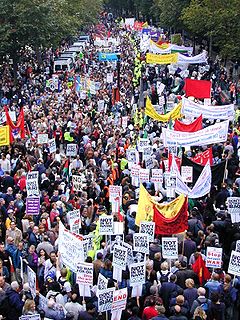
For example, can you remember what you were doing on Saturday 15th February 2003? As historians we should be acutely aware of how useless it is to rely on one’s personal memory which is invariably partial and defective. Even so, I can recall well that on that Saturday I, along with two million others, were on the largest march ever in British history, organised by the Stop the War Coalition, against the war in Iraq. At the time it could not be ignored and it is still widely recalled. Recently I had a casual discussion with a union official about someone we had both met on that demo as a youngster who by 2009 had become a socialist activist. That was a heartening story. So clearly any historical account of the Noughties will need to have the 15th February 2003 as one of its key events.
Or at least that’s what you might think. But on 17th October the Guardian published a whole issue of its Weekend magazine covering the Noughties without any mention of the demo. Nor did it carry any comment on its omission the following week. On that basis I think we may be fairly sure that some, although certainly not all, editorial voices at the Guardian would prefer not to recall 15th February 2003. It was a huge demo and it was anti-war, both subjects that they find difficult. It goes wider than that. From the first demonstration against war in Afghanistan in autumn 2001 through to the protests against the Iraq war and now Afghanistan again, not forgetting the huge protests around Gaza earlier this year and Lebanon in 2006, anti-war activities have been a consistent theme of the Noughties.
We are set to be deluged with histories of the Noughties so there is a task for socialist historians this winter.
You may see a review of the decade published that does not mention the efforts of the Stop the War Coalition, or, as likely, simply chunters on about the ‘War on Terror’ and how fighting illegal wars is absolutely necessary to the security of the UK without suggesting in any way that not everyone has agreed. If so, then write or e-mail in and complain.
We have a chance now to shape how the history of the past decade is written and we owe it to future generationsto make sure that history includes the cold but inspiring Saturday in Hyde Park in 2003 and the impact the Stop the War Coalition has had here and internationally in the last ten years.Of course it is far too soon to say what the historical impact of the anti-war movement will be, but the first task is to make sure that
is on the historical agenda in the first place.
KF
Subscribe to:
Posts (Atom)