We have received this query from Brian Smith relating to Eric Hobsbawm and oral history - if anyone can help Brian please contact Keith Flett at the address above - many thanks
'I have a vivid memory of reading something by Hobsbawm to the effect that when he started to research the late 19th century history of the British Labour movement, via veterans [ie those active in the late 19th and early 20th century labour movement who Hobsbawm presumably spoke to while putting together Labour's Turning Point (1948)], he quickly realised that he had to know more than they did about the subject if they were going to be useful. Unfortunately I can't remember where I saw it, and Richard Evans tells me he never has. I wonder: would it be possible to put a note on the socialist historians site? I am sure someone there knows about it, and it's a very useful quotation!'
Showing posts with label Oral history. Show all posts
Showing posts with label Oral history. Show all posts
Sunday, 12 January 2020

Thursday, 5 September 2019
Remembering the Stop the Seventy Tour campaign
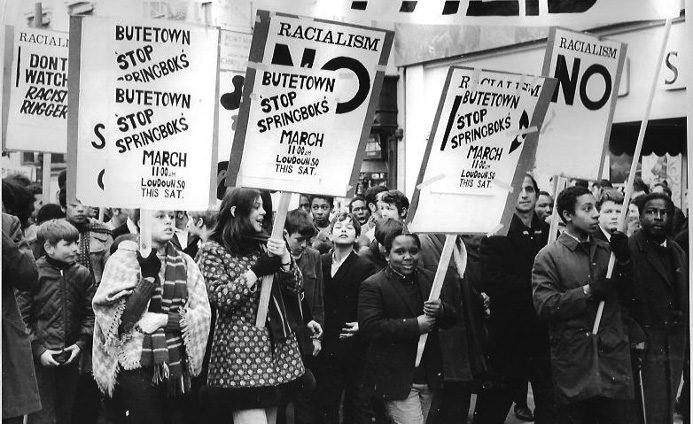
Anti-apartheid supporters marched from Bute Town in Cardiff to protest at the Springboks v Cardiff rugby match on 13 December 1969. Copyright © Morning Star - from here: https://www.aamarchives.org/campaigns/sport.html
Autumn 1969 and Spring 1970 saw demonstrations and pitch invasions of grounds to disrupt the Springboks rugby team - representing apartheid South Africa - as they toured Britain and Ireland. Organised by the Stop the Seventy Tour Committee with the support of the Anti-Apartheid Movement, this mass civil disobedience in the face of police brutality successfully stopped the 1970 South African cricket tour and future cricketing tours until apartheid fell - a victory for anti-racists everywhere and a tremendous example of international solidarity. We are researching the campaign and its roots for a pamphlet to be published early next year to mark the victory - and would very much welcome testimony or memories from any involved in this inspiring campaign. Please find us at geoff.brown@gmail.com or c.hogsbjerg@brighton.ac.uk - many thanks
In solidarity,
Geoff Brown and Christian Hogsbjerg
Monday, 24 June 2019
Invisible Lives - Doris Hatt
Dear LSHG,
I am contacting you as I felt your readers may be interested to learn about the remarkable story of Doris Hatt, an overlooked artist who was a very active member of the Communist Party Of Great Britain whilst remaining a popular member
of community life within a deeply Conservative corner of Britain during the 1930’s to 1960’s. I have two segments that tell her story which can be accessed via iTunes with a search for “Invisible Lives”, ( a not for profit venture,) or under my name. You can
also access the hosting service here :
http://www.buzzsprout.com/330380
Whilst it is short notice, there is an excellent exhibition which runs for another 10 days at the Museum Of Somerset in Taunton. Again, your members may be interested to know about this.
Saturday, 24 November 2018
CfP: Work - Recording change in working lives
The Oral History Society (in association with Llafur and Britain at
Work) will be holding its 2019 annual conference at Swansea University
on the subject of 'Oral History @ Work: Recording Change in Working
Lives'. The conference will take place on 5-6 July 2019.
We are currently seeking proposals for conference papers (closes on 14
December 2018) and would appreciate it if you could forward this email
to friends, colleagues and mailing lists who may be interested.
Note on proposals
The deadline for submission of proposals is 14 December 2018. Each
proposal should include: a title, an abstract of between 250-300 words,
your name (and the names of any co-presenters, panellists, etc), your
institution or organisation, your email address, and a note of any
particular requirements. Most importantly your abstract should
demonstrate the use of oral history or personal testimony and be
directly related to the conference theme. Proposals that include audio
playback are strongly encouraged. Proposals should be emailed to the
Oral History @ Work conference Administrator, Polly Owen, at
polly.owen@ohs.org.uk. They will be assessed anonymously by the
conference organisers, and presenters will be contacted in
January/February 2019.
Further information on the conference can be found here:
http://www.ohs.org.uk/wordpress/wp-content/uploads/OHSconf2019_CfP_web-1.pdf
Work) will be holding its 2019 annual conference at Swansea University
on the subject of 'Oral History @ Work: Recording Change in Working
Lives'. The conference will take place on 5-6 July 2019.
We are currently seeking proposals for conference papers (closes on 14
December 2018) and would appreciate it if you could forward this email
to friends, colleagues and mailing lists who may be interested.
Note on proposals
The deadline for submission of proposals is 14 December 2018. Each
proposal should include: a title, an abstract of between 250-300 words,
your name (and the names of any co-presenters, panellists, etc), your
institution or organisation, your email address, and a note of any
particular requirements. Most importantly your abstract should
demonstrate the use of oral history or personal testimony and be
directly related to the conference theme. Proposals that include audio
playback are strongly encouraged. Proposals should be emailed to the
Oral History @ Work conference Administrator, Polly Owen, at
polly.owen@ohs.org.uk. They will be assessed anonymously by the
conference organisers, and presenters will be contacted in
January/February 2019.
Further information on the conference can be found here:
http://www.ohs.org.uk/wordpress/wp-content/uploads/OHSconf2019_CfP_web-1.pdf
Thursday, 10 August 2017
North East Labour History Society - Fifty Years of Activism Day School
Day School: Fifty Years of Activism
September 16 @ 9:30 am - 4:30 pm

Venue: University of Northumbria, Ellison Building
9:30am to 4:30pm, Saturday 16 September 2017
(Exact details of location at Northumbria University will be posted here soon).A collaboration between the Histories of Activism Group at Northumbria University, and the North East Labour History Society.
This day school will reflect on the last fifty years in the North East, and especially the great changes that have occurred in politics, culture and society.The workshops will focus on specific subjects such as Labour Activism and Music and we believe it will revive the spirit of the History Workshop conferences. The backgrounds of the participants will be mixed, including academics presenting their research, as well as activists and historians working outside of a formal academic framework.
To book your place in this Day School, please let us know on moderator@nelh.net. Attendance is free, and coffee and lunch will be provided.
Fifty Years of Activism
9:30 – 10:00 Coffee and Registration10:00 – 11:00 Plenary, Keynote Speaker: Dr John Charlton
11:00 – 11:30 Coffee
11:30 – 1:00 Three parallel workshops:
Culture and Music: Workshop Leader, Dr Jude Murphy
Labour Activism: Workshop Leader, Ben Sellers
Women and the Women’s Movement: Workshop Leader, Dr Liz O’Donnell. During this session Dr Julie Scanlon will be talking about her research into the 1976 Women’s Liberation Conference held in Ponteland.
1:00 – 2:00 Lunch2:00 – 3:00 Three Parallel Workshops
The Peace Movement: Workshop Leader, John Creaby
Politics: Workshop Leader, Nigel Todd
Cooperatives: Workshop Leader, Professor Tony Webster
3:00 – 4:00 Three Parallel Workshops
Trade Unions and the World of Work: Workshop Leader, John Stirling will
begin with a brief overview of the changes in work and trade unions
over the last 50 years and focus on changing ideas about ‘workers
control’ to illustrate developments. He will then welcome discussion
from participants about how they see the past and envisage the future.
Growth of Ethnic Diversity in the North East: Workshop Leader, Dr Avram Taylor
Gala: Dr Carol Stephenson and Dave Wray
4:00 – 4:30 Concluding Remarks: Dr Matt PerryTo book your place in this Day School, please let us know on moderator@nelh.net. Attendance is free, and coffee and lunch will be provided.
__________________________________________
Tuesday, 16 May 2017
Remembering the Battle of Wood Green - 23 April 1977
[From London Socialist Historians Group Newsletter #61 Summer 2017]
The Battle of Wood Green, 23 April 1977: A question of history
The Battle of Wood Green took place on Saturday 23 1977 when a 1300 strong National Front march left Ducketts Common (Turnpike Lane N8) to march down Wood Green High Rd. They were opposed by 3,000 anti-fascists and large numbers of Saturday shoppers. Not all of the march made it to the final rally at Arnos School.
An event on 23 April 2017 to mark the 40th anniversary and linked the united effort then to oppose fascism with racism with the continuing fight today. About 500 people took part, including many of the original participants. 23 April was also the date of the first round of the French Presidential election…
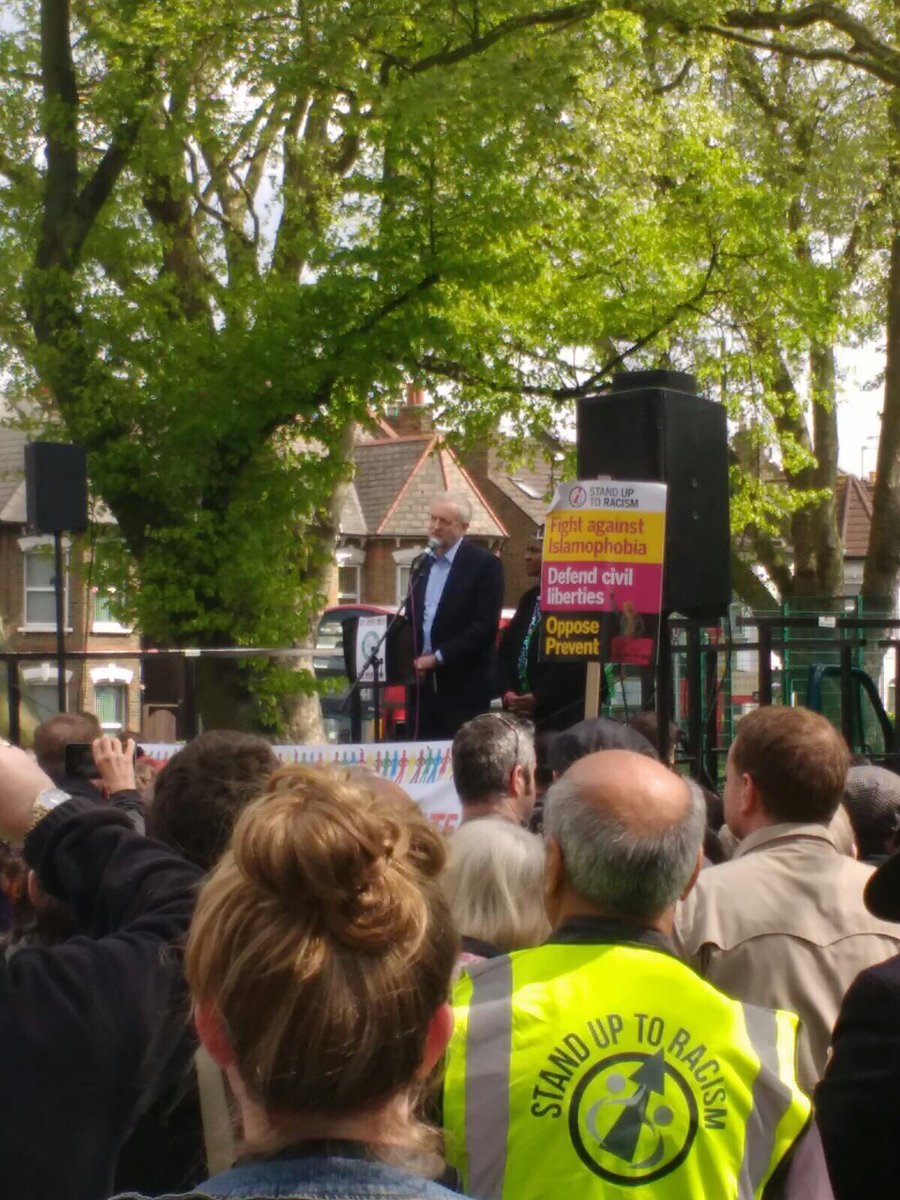
Jeremy Corbyn speaking at the event to commemorate the 40th anniversary of the Battle of Wood Green
Part of that event was a re-publication of the pamphlet published in 2007 jointly by the London Socialist Historians Group and Haringey TUC and jointly authored by Ian Birchall, David Renton and myself.
Aside from providing political analysis of what the events of 40 years ago meant, we attempted to gather memories of what had taken place (at that time) 30 years ago. It is an issue that is increasingly preoccupying the discussion at London Socialist Historians seminars at the Institute of Historical Research. The national history of the left, radical and labour movements since the 1960s is to a degree recorded in official papers, minute books, memoirs etc. When it comes to local activities or activities in particular workplaces the historical record is very patchy indeed. Local record offices often hold little or nothing often because documents are not deposited (but often thrown away) and there is not the resource to go and collect them.
When it comes to 23 April 1977 we have captured the memories of some participants. The day, as such occasions often were and are, was somewhat chaotic so what is recalled can be contradictory (and memory, not least mine, is far from always reliable). We do have the coverage of the the local paper the Hornsey Journal. What has not been done is to see if there are official papers, police files or Council paperwork, which can add to our understanding of the day.
I was privileged to speak along with Dave Morris at the Bruce Castle (Tottenham) local history event on 18th February on the Battle of Wood Green. There was an impressive audience of around 100 people some of who had been there 40 years ago. New memories, previously uncaptured, are still appearing not least about the role of a local Haringey Councillor called Jeremy who it appears went on to become rather better known, and who spoke at the commemoration.
If you have memories of the Battle of Wood Green (or any photos or documents) do get in touch.
Keith Flett
See also the twitter feed - Battle Of Wood Green (@BattleOfWoodGrn
Saturday, 18 February 2017
Oral History On The North East Labour History Website
The North East Labour History Society is pleased to announce that it has just published transcripts of the personal memories of sixty people from the North East. You can find these on our website at: http://nelh.net/oral-history/
These oral histories are from people who have spent their lives in the co-operative movement, the mines, other industries, the unions and political activity. We think these transcripts are a valuable permanent record of peoples' recollections of their lifetime experiences.
The material we have here draws on a range of activities undertaken by North East Labour History Society members and others.
Do take a look and tell us what you think. If you have transcripts or notes from interviews with people who have been involved in the labour movement in the North East we would be delighted to provide space for them on our site (contact@nelh.org). As well as the name of the interviewee and a photograph, it would be helpful to have their dates, where they lived and worked, the name of the interviewer and, if applicable, the project or organisation through which the interview was done. It is important to get permission from the person who has been interviewed to put their information on this site.
David Connolly
Secretary
Subscribe to:
Posts (Atom)