From LSHG Newsletter, No. 37, (January 2010)
Points of View: Capturing the 19th century in photographs
British Library
96 Euston Road, London, NW1 2DB until 7th March 2010
Most of the exhibitions run at the British Library are free and many of them are of some interest to socialist
historians. The current major exhibition brings together items from the Library’s extensive photographic archives and is perhaps particularly relevant at a time when we read media reports of increased police harassment of photographers on the grounds that they could be terrorists taking pictures of potential targets. (Being police officers they will never have heard of Google Earth that allows the terrorist to do this from the safety of their hide out.)
The BL exhibition has the hallmark of one of the ‘blockbuster’ exhibitions that run at this and similar national institutions in that it is clearly constructed around the materials that the Museum has - which are obviously huge - and the ‘take’ that particular specialists and archivists have on their particular area.
In that sense the exhibition is uneven, designed to appeal to a wide range of visitors and telling a number of different stories rather than focusing on a tightly drawn theme, which some of the smaller BL exhibitions, for example the recent one on 1968, have done.
The general narrative is around how the development of photography from the mid-Victorian period both mirrored the developing capitalist world and helped to shape it.
The exhibition captures the battle for the commercial exploitation of the photo from the 1850s, which can be
summed up by the explosion in personal portraits used as mementoes of visits and calling cards. The underlying commercial mechanism and motive at work remains with us today but the photograph was the first technological development to exploit it, a sort of Victorian version of the society of the spectacle. As one might guess the point is implied rather than explicit in the exhibition itself.
The sections on the imperial gaze and how colonial authorities [mainly British] used photography to classify
and control populations are particularly sharply drawn. The exhibition shows how by photographing and recording things the imperial authority could also in some senses demonstrate power over it. That applied not only to keeping records of geographical locations but also of course of people. In this latter case the imperial idea was to keep a photographic record of ethnic groups which were allegedly in decline, a sort of worldwide Cecil Sharp. The whole thing is ideologically loaded but fascinating for the
historian.
Much of the rest of the exhibition shows how photography recorded the developing world and social relations of Victorian capitalism - a world both distant but still at root instantly familiar to us today.
There are sections which reflect the development of industry and of urban environments, but also
interesting sections reflecting the development of photographic techniques. The history of the panorama is documented as are experiments in how successive still images could lead to the illusion of movement.
The exhibition provides a fascinating source for historical reflection in a society that is dominated by the image. One issue that might engage socialist historians is the relationship of Marx and Engels to the development of photography and its commercial exploitation. It is not covered in the exhibition but Eleanor Marx noted of her father:
When, after the death of his wife, Marx undertook a long, sad journey to recover his health -- for he wanted to complete his work -- he always had with him the photograph of his father, an old photograph of my mother on glass (in a case) and one of my sister -- Jenny. We found them after his death in his breast pocket. Engels laid them in his coffin.
Sunday, 31 January 2010

Work in Progress: Tony Cliff: Biography
Work in Progress: Ian Birchall on writing Tony Cliff's Biography
From LSHG Newsletter, No. 37, January 2010

Many comrades and friends have enquired after the progress of my biography of Tony Cliff. Without
wishing to commit myself too firmly, I am hoping to have a first draft completed within the next six months. While I recognise that I have taken an inordinately long time on the job, I can only plead that Cliff lived a very long life and that he was remarkably active. A whole number of people have told me that at various phases of their lives Cliff used to telephone them every single day. If the British authorities should make available the tapes of Cliff’s phone calls, it would add another five years to my task.
Moreover Cliff’s life is tied up with a number of historical topics – Palestinian Trotskyism, the crisis of the revolutionary left in the aftermath of World War II, industrial militancy in Britain in the early 1970s etc.
I have conducted over a hundred interviews with people who knew Cliff at various times in his life. These include a number of former members of the SWP and its predecessor organisations who have in some cases moved quite a long way politically, including three former MPs and a member of the House of Lords. While the interviews focus on memories of Cliff, of necessity many of those interviewed also talk about their own personal evolution, so the material (much of which will not be used in the book) will be of value to researchers on the history of the British left.

For example, I recorded a two-hour interview with Chris Harman shortly before his untimely death, in which he spoke of his own first political involvement in an independent left youth group formed after the 1959 election in Watford (and loosely connected with the similar group in Newcastle described in John Charlton’s recent book Don’t you hear the H-bomb’s Thunder?). While there may be problems about making this material public in the immediate future, I hope it will eventually be archived and available to researchers. I have also found some fascinating material in the Modern Records Centre at Warwick University. Cliff’s own papers include two unpublished books – one on the Middle East, the other on the collectivisation of agriculture. Hopefully at some point they can be scanned and placed on the Marxist Internet Archive. We also have the booklet which constitutes Cliff’s Certificate of Registration with the Irish authorities during the period he was resident in Dublin, and which gives the exact dates of his visits to England during the period of the foundation of the Socialist Review Group.
The Ken Tarbuck archive contains minutes and correspondence from the early years of the Socialist Review Group, including a letter to Natalia Trotsky inviting her to write for Socialist Review - this apparently never received a reply. The Steve Jefferys archive contains some fascinating material about the dispute about Socialist Worker (the so-called “punk paper”) in 1978.
Other curiosities are a report of a day-school held by Shoreditch Labour Party Youth Section in 1958, where Cliff lectured on “Sex and socialism” – as far as I know the only time he spoke on this subject. I think the book will contain quite a bit that is new even for those who, like myself, knew Cliff from the 1960s onwards. For younger readers I hope it will recreate at least some aspects of one of the most remarkable characters in the history of the socialist movement.
Ian Birchall
From LSHG Newsletter, No. 37, January 2010

Many comrades and friends have enquired after the progress of my biography of Tony Cliff. Without
wishing to commit myself too firmly, I am hoping to have a first draft completed within the next six months. While I recognise that I have taken an inordinately long time on the job, I can only plead that Cliff lived a very long life and that he was remarkably active. A whole number of people have told me that at various phases of their lives Cliff used to telephone them every single day. If the British authorities should make available the tapes of Cliff’s phone calls, it would add another five years to my task.
Moreover Cliff’s life is tied up with a number of historical topics – Palestinian Trotskyism, the crisis of the revolutionary left in the aftermath of World War II, industrial militancy in Britain in the early 1970s etc.
I have conducted over a hundred interviews with people who knew Cliff at various times in his life. These include a number of former members of the SWP and its predecessor organisations who have in some cases moved quite a long way politically, including three former MPs and a member of the House of Lords. While the interviews focus on memories of Cliff, of necessity many of those interviewed also talk about their own personal evolution, so the material (much of which will not be used in the book) will be of value to researchers on the history of the British left.

For example, I recorded a two-hour interview with Chris Harman shortly before his untimely death, in which he spoke of his own first political involvement in an independent left youth group formed after the 1959 election in Watford (and loosely connected with the similar group in Newcastle described in John Charlton’s recent book Don’t you hear the H-bomb’s Thunder?). While there may be problems about making this material public in the immediate future, I hope it will eventually be archived and available to researchers. I have also found some fascinating material in the Modern Records Centre at Warwick University. Cliff’s own papers include two unpublished books – one on the Middle East, the other on the collectivisation of agriculture. Hopefully at some point they can be scanned and placed on the Marxist Internet Archive. We also have the booklet which constitutes Cliff’s Certificate of Registration with the Irish authorities during the period he was resident in Dublin, and which gives the exact dates of his visits to England during the period of the foundation of the Socialist Review Group.
The Ken Tarbuck archive contains minutes and correspondence from the early years of the Socialist Review Group, including a letter to Natalia Trotsky inviting her to write for Socialist Review - this apparently never received a reply. The Steve Jefferys archive contains some fascinating material about the dispute about Socialist Worker (the so-called “punk paper”) in 1978.
Other curiosities are a report of a day-school held by Shoreditch Labour Party Youth Section in 1958, where Cliff lectured on “Sex and socialism” – as far as I know the only time he spoke on this subject. I think the book will contain quite a bit that is new even for those who, like myself, knew Cliff from the 1960s onwards. For younger readers I hope it will recreate at least some aspects of one of the most remarkable characters in the history of the socialist movement.
Ian Birchall
The Noughties: Making Our History Count
Keith Flett on the Noughties: Making our history count
From LSHG Newsletter, No. 37 (January 2010)
No doubt many readers of this Newsletter have been busy in recent months, as I have myself, sorting out solidarity with the CWU, opposing the BNP and campaigning to get troops out of Afghanistan. Busy or not, time moves on and that means that history is being written all the time.
Of course assessments of the last few months, or even of 2009, are journalism not history, but as the first decade of the twenty-first century, the Noughties, draws to a close, the initial very provisional attempts to write its history will be made.
Any judgements on the last decade cannot be anything but the very first drafts of history that will need to be reviewed as memoirs and official records become available in decades to come.
Nevertheless judgements made now may set the tone for later understandings and that means the battle as to how we understand the past ten years is already being joined.
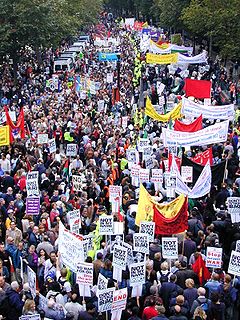
For example, can you remember what you were doing on Saturday 15th February 2003? As historians we should be acutely aware of how useless it is to rely on one’s personal memory which is invariably partial and defective. Even so, I can recall well that on that Saturday I, along with two million others, were on the largest march ever in British history, organised by the Stop the War Coalition, against the war in Iraq. At the time it could not be ignored and it is still widely recalled. Recently I had a casual discussion with a union official about someone we had both met on that demo as a youngster who by 2009 had become a socialist activist. That was a heartening story. So clearly any historical account of the Noughties will need to have the 15th February 2003 as one of its key events.
Or at least that’s what you might think. But on 17th October the Guardian published a whole issue of its Weekend magazine covering the Noughties without any mention of the demo. Nor did it carry any comment on its omission the following week. On that basis I think we may be fairly sure that some, although certainly not all, editorial voices at the Guardian would prefer not to recall 15th February 2003. It was a huge demo and it was anti-war, both subjects that they find difficult. It goes wider than that. From the first demonstration against war in Afghanistan in autumn 2001 through to the protests against the Iraq war and now Afghanistan again, not forgetting the huge protests around Gaza earlier this year and Lebanon in 2006, anti-war activities have been a consistent theme of the Noughties.
We are set to be deluged with histories of the Noughties so there is a task for socialist historians this winter.
You may see a review of the decade published that does not mention the efforts of the Stop the War Coalition, or, as likely, simply chunters on about the ‘War on Terror’ and how fighting illegal wars is absolutely necessary to the security of the UK without suggesting in any way that not everyone has agreed. If so, then write or e-mail in and complain.
We have a chance now to shape how the history of the past decade is written and we owe it to future generationsto make sure that history includes the cold but inspiring Saturday in Hyde Park in 2003 and the impact the Stop the War Coalition has had here and internationally in the last ten years.Of course it is far too soon to say what the historical impact of the anti-war movement will be, but the first task is to make sure that
is on the historical agenda in the first place.
KF
Thursday, 28 January 2010
Reassessing Gerrard Winstanley
Reassessing Gerrard Winstanley
Keele University 5-6 February 2010
Speakers include Chris Rowland, Nigel Smith, John Gurney, Ariel Hessayon, Ann Hughes, Tom Corns.
The conference will discuss Winstanley as political thinker and activist, as radical theologian, and as prose stylist. It is held in connection with the publication for the first time of a complete edition of Winstanley’s writings, and marks the 400th anniversary of his birth. Plenary lecture admission free (Friday); conference registration £25 to include lunch on Saturday. Accommodation available.
For further details contact Ann Hughes: a.l.hughes@keele.ac.uk
Keele University 5-6 February 2010
Speakers include Chris Rowland, Nigel Smith, John Gurney, Ariel Hessayon, Ann Hughes, Tom Corns.
The conference will discuss Winstanley as political thinker and activist, as radical theologian, and as prose stylist. It is held in connection with the publication for the first time of a complete edition of Winstanley’s writings, and marks the 400th anniversary of his birth. Plenary lecture admission free (Friday); conference registration £25 to include lunch on Saturday. Accommodation available.
For further details contact Ann Hughes: a.l.hughes@keele.ac.uk
Howard Zinn (1922-2010)
Howard Zinn, legendary people's historian of the United States, has died. This is indeed a sad day for socialist and radical historians internationally - condolences to those who were close to him from the LSHG.
Monday, 25 January 2010
LSHG Conference: The Vote - What Went Wrong?
The Vote- What Went Wrong?
Saturday 27th February
Institute of Historical Research
Senate House, London WC1

Some recommended reading on the subject
The recent scandal over Parliamentary expenses has raised
major questions about Parliamentary democracy and its
relationship to the labour movement and the left.
Historically the left has fought for democracy and the
vote from the Chartists to the Suffragettes to those
who campaigned against the disenfranchisement of black voters in
the US and Catholics in the North of Ireland in the 1960s.
There has been since at least the 1960s in the UK a link
between social democracy and corruption, but the
same has also applied elsewhere, for example in Italy.
Has the attempt to democratise Parliamentary institutions
led simply to a replication of the Old Corrupt practices of
the past? Finally the conference will examine alternative
strategies for democracy on the left, not least the
Soviets and workers councils that have appeared at
moments in the last 140 years or so from the Paris
Commune onwards.
Conference Papers [alpha order]
Owen Ashton - 'W E Adams, Chartism and Republicanism'
Logie Barrow - 'Enfranchisement and Stupefaction: vaccination and the vote'
Ian Bullock - 'Gulfs, fissures and cracks. Democracy and the British Left in the early 20th Century'
Neil Davidson - 'Social Neoliberalism, "Regimes of Consolidation" and the Assault on Representative Democracy, 1989-2008'
Keith Flett - 'The origins of the electoral impulse in the British working class'
Mike Haynes - 'Parliament: The Return of Old Corruption'
Advance Registration is encouraged:-
Send cash or cheque [made payable to Keith Flett] for £10 [£5 concs] to LSHG, 38 Mitchley Rd, London N17 9HG
Saturday 27th February
Institute of Historical Research
Senate House, London WC1

Some recommended reading on the subject
The recent scandal over Parliamentary expenses has raised
major questions about Parliamentary democracy and its
relationship to the labour movement and the left.
Historically the left has fought for democracy and the
vote from the Chartists to the Suffragettes to those
who campaigned against the disenfranchisement of black voters in
the US and Catholics in the North of Ireland in the 1960s.
There has been since at least the 1960s in the UK a link
between social democracy and corruption, but the
same has also applied elsewhere, for example in Italy.
Has the attempt to democratise Parliamentary institutions
led simply to a replication of the Old Corrupt practices of
the past? Finally the conference will examine alternative
strategies for democracy on the left, not least the
Soviets and workers councils that have appeared at
moments in the last 140 years or so from the Paris
Commune onwards.
Conference Papers [alpha order]
Owen Ashton - 'W E Adams, Chartism and Republicanism'
Logie Barrow - 'Enfranchisement and Stupefaction: vaccination and the vote'
Ian Bullock - 'Gulfs, fissures and cracks. Democracy and the British Left in the early 20th Century'
Neil Davidson - 'Social Neoliberalism, "Regimes of Consolidation" and the Assault on Representative Democracy, 1989-2008'
Keith Flett - 'The origins of the electoral impulse in the British working class'
Mike Haynes - 'Parliament: The Return of Old Corruption'
Advance Registration is encouraged:-
Send cash or cheque [made payable to Keith Flett] for £10 [£5 concs] to LSHG, 38 Mitchley Rd, London N17 9HG
Tuesday, 19 January 2010
Haiti: Pawn in their Game
After the devastation of the recent earthquake in Haiti, readers might like to know that Chris Harman's concise introduction to Haitian history (from about 1786-1986) is online here. For more on the Haitian Revolution itself, readers should consult C.L.R. James's classic history of the Haitian Revolution, The Black Jacobins - which even Christopher Hitchens still has the audacity to describe as 'essential' reading while simulaneously praising US efforts to recolonise Haiti in the aftermath of the earthquake - despite of course James's own stress in The Black Jacobins that there is more 'decency, gratitude, justice and humanity in a cage of starving tigers than in the councils of imperialism'. For the period after the Duvaliers and on Aristide, see Peter Hallward's Damming the Flood: Haiti, Aristide and the Politics of Containment.
Edited to add: Five upcoming academic conferences on Haiti/the Caribbean
(1)Haiti and the Politics of the Universal, The Centre for Modern Thought at the University of Aberdeen (Scotland)
Friday and Saturday, March 12-13, 2010
(2) INTERNATIONAL CONFERENCE
FROM DUVALIER TO PRÉVAL:
HAITI YESTERDAY, TODAY & TOMORROW
INSTITUTE FOR THE STUDY OF THE AMERICAS
Senate House, London, WC1E 7HU
21ST – 22ND JUNE 2010
(3) Caribbean Enlightenment conference,
An Interdisciplinary Caribbean Studies Conference
8th to 10th April 2010, University of Glasgow
(4) Afromodernisms 1: Re-encounters with the French and Anglo-Atlantic Worlds, 1907–61.
Symposium: University of Liverpool, UK. Thursday 15th April - Saturday 17th April.
(5) Caribbean Globalizations: Histories, Cultures and Genres, 1493 to the Present Day
University of Oxford, 27-29 September 2010
Edited to add: Five upcoming academic conferences on Haiti/the Caribbean
(1)Haiti and the Politics of the Universal, The Centre for Modern Thought at the University of Aberdeen (Scotland)
Friday and Saturday, March 12-13, 2010
(2) INTERNATIONAL CONFERENCE
FROM DUVALIER TO PRÉVAL:
HAITI YESTERDAY, TODAY & TOMORROW
INSTITUTE FOR THE STUDY OF THE AMERICAS
Senate House, London, WC1E 7HU
21ST – 22ND JUNE 2010
(3) Caribbean Enlightenment conference,
An Interdisciplinary Caribbean Studies Conference
8th to 10th April 2010, University of Glasgow
(4) Afromodernisms 1: Re-encounters with the French and Anglo-Atlantic Worlds, 1907–61.
Symposium: University of Liverpool, UK. Thursday 15th April - Saturday 17th April.
(5) Caribbean Globalizations: Histories, Cultures and Genres, 1493 to the Present Day
University of Oxford, 27-29 September 2010
Subscribe to:
Posts (Atom)